Fly Ash

Processed Fly ASH and Various Grades :

GUARD 100 : GUARD 100 is ultrafine fly Ash is a very high efficiency pozzolanic material for use as a component of cement with portland clinker to yield high performance concrete. The particle size :-Xero (0)% retention on 45 micron sieve.It is a top of the range product in terms of all international Standard Specifiacation for fly ash and is subjected to stringent quality control.

GUARD 83 :-GUARD 83 is high efficiency pozzolanic material use as partial cement replacement in hgh performance concrete . The Particle size :-5% max retention on 45 micron sieve.

GUARD 63 :-GUARD 63 is high efficiency pozzolanic material use as partial cement replacement. The particle size :- 10% max retention on 45 micron sieve. This grade meets IS3812 Part 1 specification.

GUARD 60 :-GUARD 60 is high efficiency pozzolanic material use as partial cement replacement. The particle size :- 18% max retention on 45 micron sieve. This grade meets IS3812 Part 1 specification.

GUARD 40 :-GUARD 40 Is high pozzolanic material use as cement replacement in mass concrete, low grade and medium concrete. The particle size :-25% max retention on 45 micron sieve.It confirms to ASTM -C 618 specification.

P30:-The P30 is pozzolanic material use as cement replacement in mass concrete, low grade and medium concrete.The paticle size :-34% max retention on 45 micron sieve .

P20 :- P20 is a filler material.It is subjected to quality control, P20 Can be use as a filler in concrete and precast concrete blocks and elements. The particle size :-35 to 60% retention on 45 micron sieve.

P10 :- P10 is a filler material.It is subjected to quality control,it can be uses in combination with natral sand and crush sand, Also used in precast concrete block and elements.The particle size :- 60 to 85% retention on 45 micron sieve .

Every tonne Portland clinker produced produced even with the best of technologies ctreates 0.9 tonnes od CO2 is one of the main contributors to the Greenhouse effect. Using GUARD Instead of portland cements (portland clinker) can save up to 1 million tonnes of CO2 emmision per year.
POZZOGUARD

The Materials

POZZOGUARD is obtained by processing fly ash produced as a byproduct at coal-fired electricity generating power stations. In unprocessed form, fly ash (run-of-station ash) can be a highly inconsistent and unpredictable material, rendering it unsuitable for use as a component of cement in concrete. Processing of fly ash to produce POZZOGUARD entails in the main controlling its fineness (and thereby particle size and distribution, shape and glass content) and unburnt carbon (loss-onignition) and thus producing a material that can be used with confidence to make concrete that is readily consistent and is of high quality.
POZZOGUARD (processed fly ash) has a successful history of use in concrete around the world as a pozzolanic material. It complements Portland clinker by reacting with Ca(OH) released from the hydration of the 2 clinker. As a great deal of energy is created during coal combustion, POZZOGUARD has some unique properties in the form of its physical and chemical characteristics.


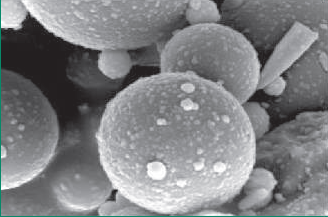
Figure 1. POZZOGUARD particle shape and size


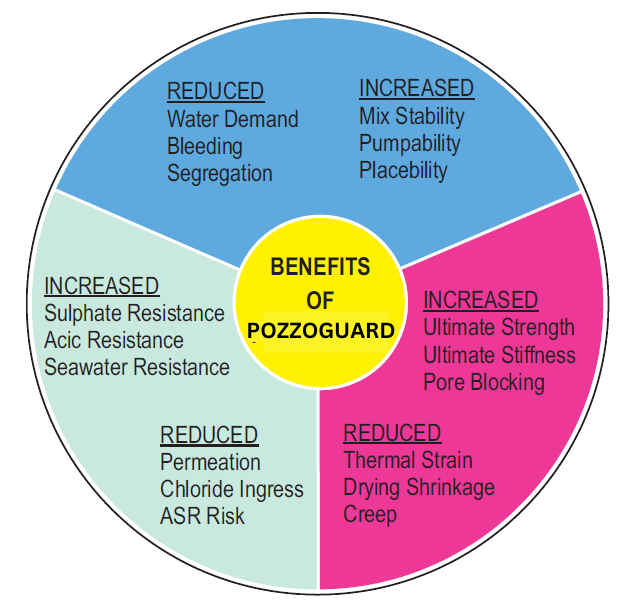
POZZOGUARD essentially consists of spherical particles (Figure1), which improves the performance of concrete in the fresh state. In composition, the main oxides are similar to those of Portland clinker (Table1), but with very different proportions and mineralogy, which is primarily glass that is responsible for its pozzolanic characteristics. This allows POZZOGUARD not only to displace Portland clinker, but also to bring about significant benefits to concrete in terms of its engineering properties and durability (Figure 2).
POZZOGUARD is produced in four grades, all of which are of better quality than that required by major national standard specifications, with POZZOGUARD 83 being of the highest quality followed by POZZOGUARD 63, 60, and 40, as shown in Table 2.


Composition (%) Portland Clinker Pozzoguard
SiO2 21.0 57.2
AI202 4.9 31.1
Fe2O2 2.6 3.3
CaO 64.6 2.3

Table 1. Typical major oxide composition of GUARD and Portland clinker

Figure 2. Improving concrete performance with POZZOGUARD

Specification International Standards GUARD
ASTM 618 BS EN 450 IS 3812 Pozz 40 Pozz 60 Pozz 63 Pozz 83
S N
Fitness (min) m²/kg - - 320 280 320 400 475
ROS 45 (max), % 34 12 40 34 25 18 10 5
Loss on Ignition (max), % 6.0 7.0 7.0 5.0 2.5 2.5 2.5 2.5
Water Requirement (max), % 115 95 - 100 95 95 95
Moisture Content (max), % 3.0 - - 2.0 0.5 0.5 0.5 0.5
Soundless by Autoclave, % 0.8 10 mm 0.8 0.2 0.1 0.1 0.1 0.1
28 days strength (min), % 75 75 80 80 85 90 90
Lime Reactivity (min), N/mm² - - - 4.5 5.0 5.5 6.0
Chemical Analysis - - - - - - - -
SiO2 + AI2O3 + Fe2o3 (min), % 70 70 70 70 90 90 90 90
SiO2 (min), % - - 35 50 50 50 50
CaO (max), % 10 10 - 5.0 5.0 5.0 5.0
MgO (max), % - 4.5 5.0 4.0 4.0 4.0 4.0
SO3 (max) 4.5 3.0 3.0 2.0 2.0 2.0 2.0
Na2 (max), % - 5.0 1.5 1.5 1.5 1.5 1.5
Total Chlorides - 0.10 0.05 0.05 0.05 0.05 0.05

Table 2.


POZZOGUARD

Use in Concrete

POZZOGUARD can be specified in all grades of concrete, for all forms of construction and with ready-mixed, precast and on-site applications. It offers wide ranging benefits to concrete in its fresh state (such as consistence, stability and finish) and hardened state (such as strength, stiffness and drying shrinkage), as well as permeation and durability (Figure 2).
In fresh concrete, advantage can be taken of the ability of POZZOGUARD to improve its handling properties. For example, concrete using POZZOGUARD can be particularly amenable to pumping and its finish, with either hand or power tools can be excellent. Admixtures specially developed for use with fly ash could further extend the performance of concrete made with POZZOGUARD . It can also be effectively used where aggregates have poor grading and shape and as result of which concrete becomes harsh and prone to bleeding and segregation.
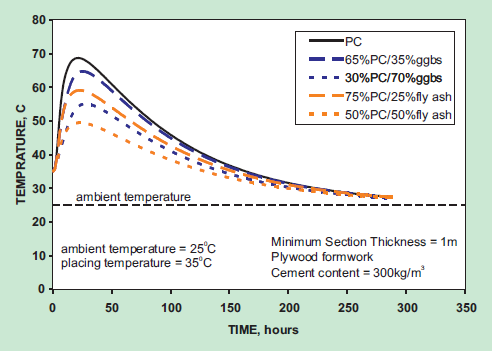
POZZOGUARD is particularly suited for mass concrete applications and concrete in hot and aggressive climates (Figure 3), where heat of hydration and the associated temperature rise in concrete and the risk of early-age thermal cracking are major concerns. Indeed, controlling temperature rise in concrete with POZZOGUARD offers, at no extra cost, additional benefits of enhanced durability.


Figure 3. Effect of BS EN 197 cement additions on peak temperature of concrete


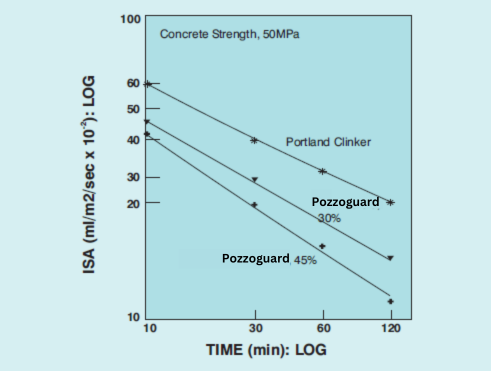
Figure 4. Improvement in the permeation of concrete with POZZOGUARD


POZZOGUARD

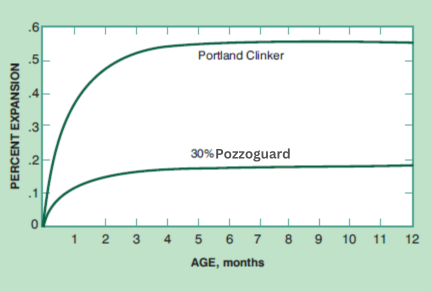
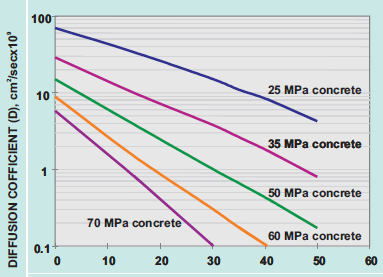
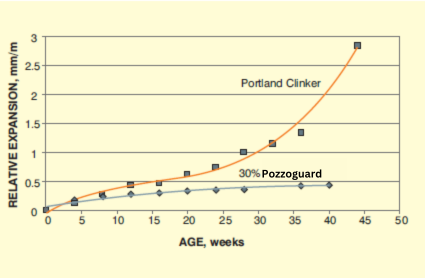
POZZOGUARD , due to its particle size and shape and its pozzolanic nature can significantly improve the permeation properties of concrete (Figure 4). Most national and international standards now include the use of processed fly ash (POZZOGUARD ) in specifying concrete for most severe exposure conditions. GUARD is particularly suited for improving the resistance of concrete to chlorides ingress (Figure 5), sulphate attack (Figure 6) and alkali-silica reaction (Figure 7).


Figure 7. POZZOGUARD enhances concrete resistance to ASR

Figure 5. POZZOGUARD enhances concrete resistance to chloride ingress


Figure 6. POZZOGUARD enhances concrete resistance to sulfate attack


READY TO COLLABORATE ?

Get In Touch

Our team process the orders and aim for the timely delivery of the products and supplies. We offer products at affordable prices and timely delivery. Pozzoguard assures the premium quality of all the goods and services.
Hi Pozzoguard